Year Twenty
Station ElevenYear Twenty names the span two decades after the collapse, when the catastrophe is no longer only an immediate emergency but the point from which people count their lives and interpret the past. The Travelling Symphony is still moving through a world reshaped by the Georgia Flu, while Clark Thompson, living at Severn City Airport, turns his memories of the former civilization into a public record. The period holds both realities together: the persistence of survival and the growing distance from the systems and wonders that once made the old world seem permanent.
Dating the New Era
The calendar of this era begins with disaster. By the fourth year, Clark had recognized that the years would continue to be counted one by one from that moment. Year Twenty therefore means more than an elapsed interval: it makes the collapse the common measure of historical time, dividing experience into what came before and what has followed. Even memories of ordinary pleasures acquire the character of last occasions—the last ice-cream cone eaten in a sunlit park, the last dance in a club, the last moving bus, the last orange. Their significance comes partly from the fact that they were unremarkable when they happened; only afterward did the vanished world make them final.
Two decades on, the change is visible in the difference between the first years and the present. The first unspeakable years were marked by people travelling because they had not yet understood that there was nowhere they could walk to where life continued as before. Later, people settled in clusters for safety, often in improvised communities at truck stops, former restaurants, and old motels. With gasoline gone stale by Year Three, endless movement was no longer possible for most people. Year Twenty thus describes a world whose population has adapted to permanence without restoring the conditions that existed before the pandemic.
A Changed but Still Difficult World
The Travelling Symphony’s journey near Lake Michigan offers a close view of the period’s ordinary hardships. In late July, under a heat wave that had lasted a week, a thermometer fixed to the lead caravan read 106 Fahrenheit, or 41 Celsius. Trees crowded the road and grew through cracks in the pavement; their branches brushed the walkers and horses. Most of the company went on foot to spare the horses, which needed frequent rests in the shade. The Symphony did not know the territory well and wanted to cross it quickly, but heat made speed impossible. Its members walked with weapons in hand, while scouts watched both ahead and behind.
That danger existed alongside a measure of calm. In the territory the Symphony travelled, encounters with other travellers were rare and usually involved peddlers moving miscellaneous goods between settlements. A man approaching with a golden retriever and a rifle could speak without immediate hostility: he observed that in the first ten or twelve years after the collapse, he would have been much likelier to shoot strangers on sight. The contrast gives Year Twenty its unsettled character. It is safer than the years immediately after the disaster, but safety remains relative, dependent on local circumstances and the judgment of people who meet on the road.
Routes, Work, and Cultural Continuity
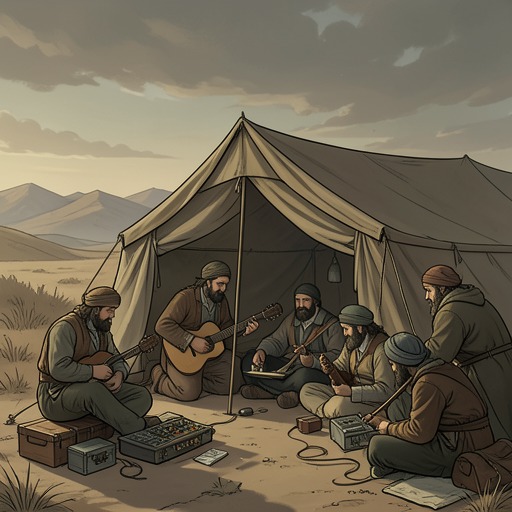
By this point, the Travelling Symphony had been on the road for fifteen years. The Conductor had gathered friends from her military orchestra five years after the collapse and left the air base where they had been living. After six months of moving between settlements, the musicians encountered Gil’s company of Shakespearean actors. The actors had escaped from Chicago together, worked on a farm for several years, and then spent three months travelling. The two groups combined their operations, creating a company that could bring both music and theatre to scattered communities.
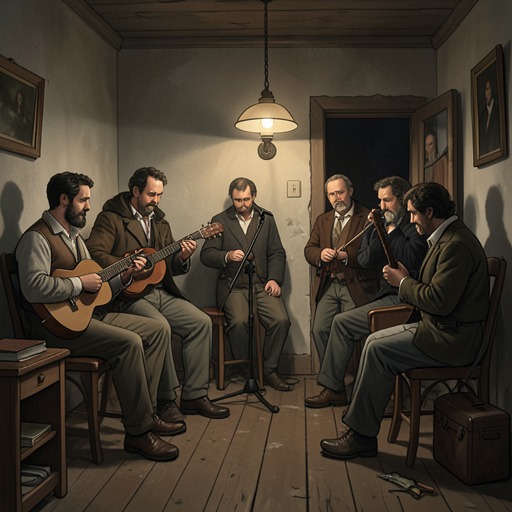
In Year Twenty, that company maintained a broad circuit through the region. It travelled along the shores of Lake Huron and Lake Michigan, west as far as Traverse City and east and north over the 49th parallel to Kincardine. It also followed the St. Clair River south to the fishing towns of Marine City and Algonac before returning. Its performances included classical and jazz music, orchestral arrangements of pre-collapse pop songs, and Shakespeare. The company had tried more modern plays in its early years, but audiences showed a preference for Shakespeare, a result its members had not anticipated. Their repertoire consequently carried old cultural works into communities whose members had not necessarily known the world in which those works were first performed.
The road also made performance part of daily discipline. During the punishing approach to St. Deborah by the Water, actors rehearsed lines while walking, musicians tried to ignore them, and scouts kept watch. Kirsten Raymonde carried a paperback of King Lear with its stage directions highlighted; she had once held a small, silent role in a short-lived Toronto production, though she could remember little of that earlier life. Rehearsal did not suspend the conditions of Year Twenty: the company’s route, weapons, tired horses, and physical fatigue remained present even as the play continued to be learned.
Memory and the Former World
For Clark Thompson, Year Twenty is also a vantage point from which to measure how much had disappeared. Near the end of his second decade at Severn City Airport, he considered himself fortunate not only to have survived but to have lived for fifty-one years in the former world. He remembered space shuttles, the electrical grid, amplified guitars, pocket-sized computers, and high-speed trains between cities. His thought, “I was there,” joined sadness to exhilaration: he had witnessed the end of one world and the beginning of another, and could still recall the first from experience rather than hearsay.
That distinction shaped Clark’s work as curator of the Museum of Civilization, housed in what had been the Skymiles Lounge in Concourse C. He took the responsibility seriously and did not accept that the past was simply too difficult to explain. The objects he had collected—from laptops and iPhones to an administrative-desk radio, an electric toaster, a turntable, and vinyl records—required context as well as display. When a sixteen-year-old born at the airport asked about the planes, Clark explained that they had not risen straight into the sky: they gathered speed along long runways and then angled upward. The example makes the museum’s task concrete. A machine can survive as an object after the practical knowledge surrounding it has faded.
The same distance separates Kirsten’s present from the life she can scarcely remember. By Year Twenty, she has memorized the two issues of Dr. Eleven that Arthur Leander gave her, though no one else in the Symphony has heard of the series. The comics depict a physicist living on a space station designed to resemble a small planet, with seas, islands, bridges, colored skies, and two moons. Their costly paper and bright images suggest that they were never ordinary mass-market books; the initials “M. C.” stand where an author’s name might have been, and pencil notes mark the copies as numbers two and three of ten. The comics persist as a small, mysterious remnant of the world that made them. Alongside Clark’s deliberate museum and the Symphony’s travelling performances, they show how Year Twenty carries the past forward through objects, memory, and repeated acts of cultural transmission.